WEA-Obs
Mapping illicit hubs in West Africa
This illicit hub mapping initiative is a flagship product of the the Observatory of Illicit Economies in West Africa (WEA-Obs) at the Global Initiative Against Transnational Organized Crime (GI-TOC). Building on mapping launched in 2022, a comprehensive mapping of 350 illicit hubs across West Africa and parts of Central Africa has been undertaken. These hubs are locations where illicit economies converge, and where their impact on conflict and instability can be assessed.
In addition to identifying key hotspots, transit points and illicit ecosystems, the project entails further analysis of each illicit hub, and its relationship with regional stability. In order to identify the illicit hubs which are most important in terms of their knock-on effect on conflict and stability across West Africa, a quantitative metric has been developed: the Illicit Economies & Instability Monitor (IEIM), which provides a score out of 33 for each illicit hub. The monitor comprises three components: violence and instability, crime-conflict links, and accelerators. The IEIM enables the identification of areas where illicit markets play the most important role as vectors of instability and conflict in the region, empowering policymakers to prioritize specific areas for targeted action.
Methodology
Three years after the initial illicit hub mapping in West Africa in 2022, the purpose of this interactive online tool and the accompanying report is to provide an updated map of hubs of illicit economies across West Africa and parts of Central Africa, and assess their intersections with conflict and instability.
As in 2022, 18 countries fall within the geographic scope of the updated mapping: the West African states of Benin, Burkina Faso, Cabo Verde, Côte d’Ivoire, Gambia, Ghana, Guinea, Guinea-Bissau, Liberia, Mali, Niger, Nigeria, Senegal, Sierra Leone and Togo, together with the Central African states of Cameroon, Central African Republic and Chad.
The multistage research was led by a core team from the GI-TOC, working with a wide network of research consultants, and a field monitoring network was established across countries of focus. An updated literature review was conducted for each country, and tailored guidance manuals were developed. Primary data collection included semi-structured interviews, conducted either in person or remotely and based on pre-prepared questionnaires, focus group discussions and roundtables, and requests for information (RFIs) sent out to elements of the network. Drawing on this, the research team developed a preliminary mapping of hubs and their characteristics, highlighting changes from the previous iteration. Each country mapping package was presented to a group of national, regional and international experts for validation, either as part of a roundtable discussion or as bilateral engagements.
The final mapping is the culmination of 18 months of research led by 11 GI-TOC researchers, supported by a team of 37 local research consultants, and a wide network of field monitors, drawing on specific consultations with over 640 stakeholders. Other WEA-Obs research workstreams, each underpinned by extensive primary data collection, also contributed to the hub mapping. A total of 77 experts were engaged through validation processes.
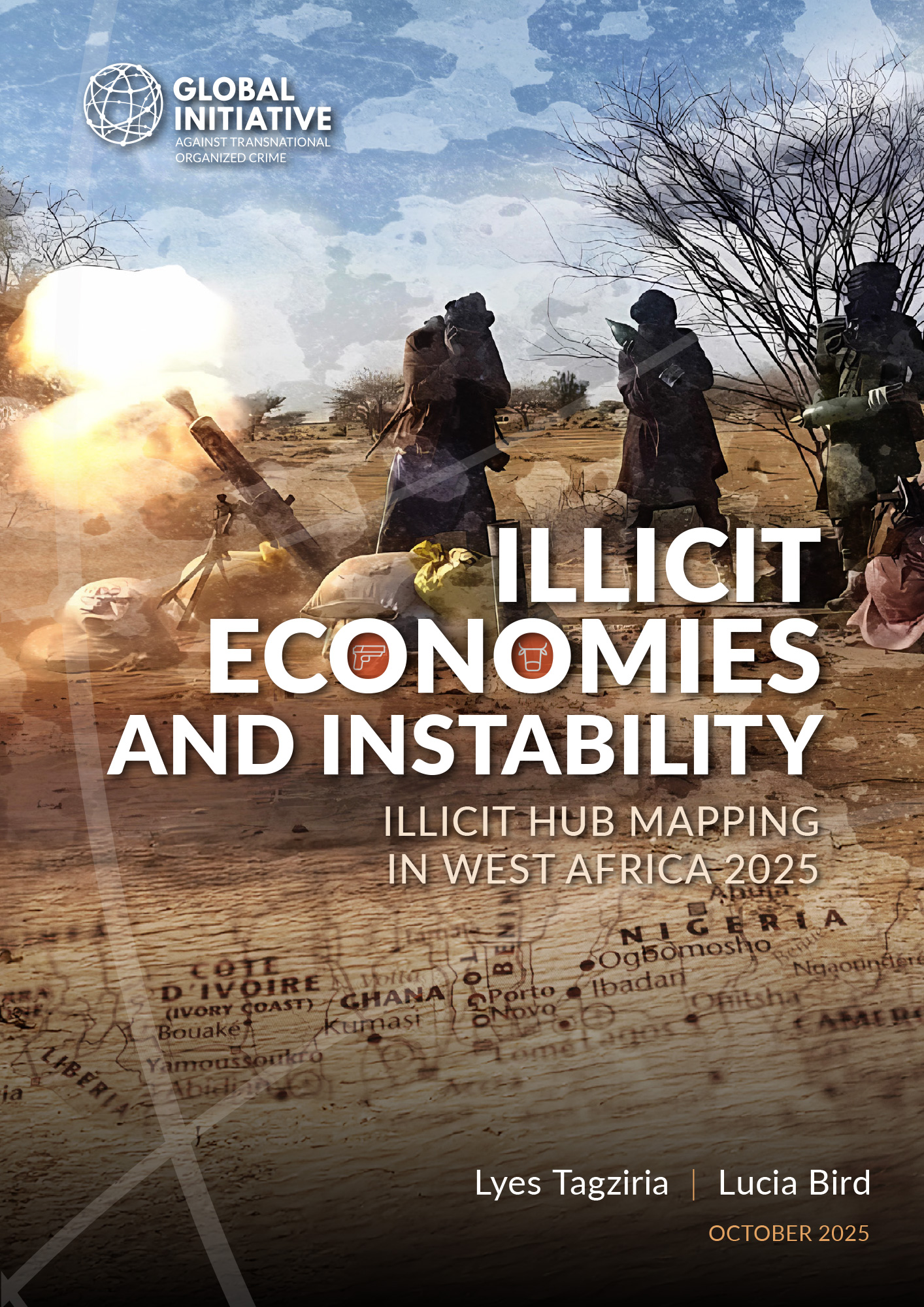
To read more about the development of the illicit hub mapping, please read the report above, Illicit economies and instability: Illicit hub mapping in West Africa 2025.
Supported by

This research is delivered by the GI-TOC as part of the ‘Support to the Mitigation of Destabilizing Effects of Transnational Organised Crime (M-TOC)’. The M-TOC project is a project commissioned by the German Federal Foreign Office, implemented by Deutsche Gesellschaft für Internationale Zusammenarbeit (GIZ) GmbH, and the GI-TOC, from 2024 to 2025.
The project aims to map regional illicit markets in West Africa in order to improve the evidence base for stabilisation and peacebuilding interventions, and to strengthen the engagement of civil society and state actors in the fight against criminal markets.